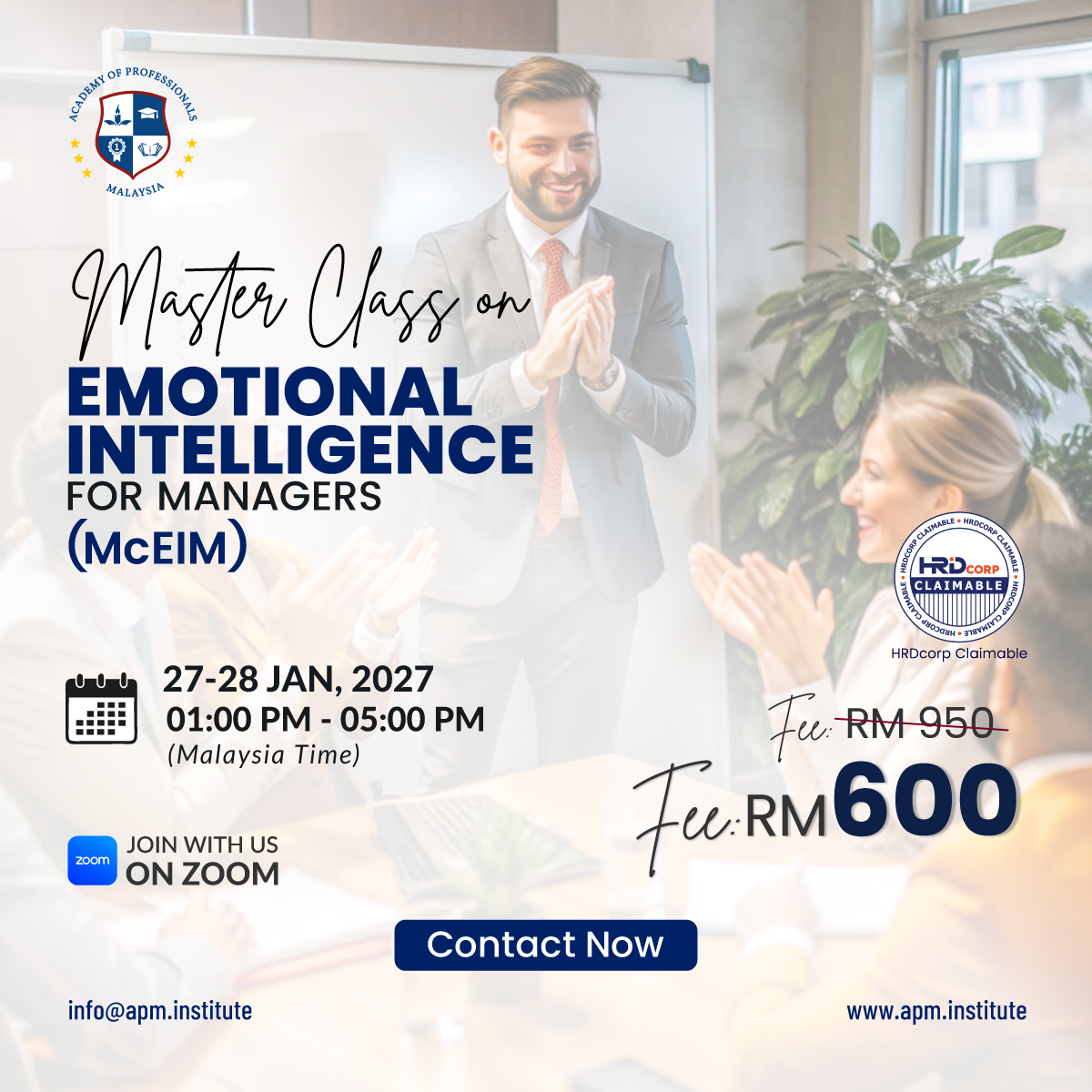
Master Class on Emotional Intelligence for Managers (McEIM)-1st Batch
This program helps managers use emotional intelligence to shape healthier, more engaged teams—especially in challenging workplace situations. Through the five-stage EQ-PULSE Model, participants practice reading emotions, managing their reactions, understanding others, and responding effectively. They leave with a personal EQ profile, practical tools and a 30-60-90-day action plan.
Managers set the emotional weather of their teams, and this programme teaches them to do it on purpose rather than by accident. Research across sectors consistently links a manager's behaviour to a large share of the variance in team engagement, discretionary effort and voluntary turnover. Technical expertise earns a promotion; emotional intelligence decides whether people want to follow.
Emotional intelligence (EI) is the capability to perceive, understand and manage emotions in oneself and others, and to use that awareness to guide thinking and action. For a manager this is not a soft extra. It shows up in hard moments: a missed deadline, a defensive employee, a restructuring announcement, a client escalation at 6 p.m., or a high performer who quietly disengages.
The programme is built on the EQ-PULSE Model, an original five-stage cycle that mirrors how an emotionally charged moment actually unfolds at work: Perceive, Understand, Lead self, Sense others, Engage. Repeated over time, these moments shape the team's emotional climate, which sits at the centre of the model.
The learning is practical and cross-sector. Cases are drawn from banking, manufacturing, healthcare, retail, IT services, hospitality, the public sector and NGOs. Participants leave with a personal EQ profile, a set of field-tested tools, and a 30-60-90-day action plan they can apply with their own teams the next morning.
-
The programme aims to move managers from reacting to emotions to leading with them. Specifically, it aims to:
- Build a shared, evidence-informed understanding of emotional intelligence and why it predicts managerial effectiveness more reliably than technical skill alone.
- Equip managers with a practical, repeatable model (EQ-PULSE) for handling emotionally charged workplace moments.
- Strengthen self-awareness of personal triggers, values, stress signatures and blind spots that shape managerial behaviour.
- Develop self-regulation techniques that keep judgement clear under pressure, ambiguity and conflict.
- Sharpen empathy and social awareness so managers can read individuals, team dynamics and organisational undercurrents accurately.
- Build relationship-management skills for feedback, difficult conversations, conflict resolution and influence.
- Enable managers to create a team climate of psychological safety, trust and motivation.
- Translate learning into a measurable personal action plan with defined behaviours, milestones and evidence of progress.
- Build a shared, evidence-informed understanding of emotional intelligence and why it predicts managerial effectiveness more reliably than technical skill alone.
-
M-1: The Emotional Economics of Management
M-2: Perceive and Understand — Self-Awareness for Managers
M-3: Lead Self — Self-Regulation and Resilience Under Pressure
M-4: Sense Others — Empathy and Social Awareness
M-5: Engage — Feedback, Conflict and Influence
M-6: Team Climate — Building an Emotionally Intelligent Team
-
Exam Method:
Number of Online Final Exams: 01
Online MCQ (Multiple Choice Question) Exam
- Number of MCQ Questions: 20
- Exam Duration: 20 Minutes
- Total Marks: 40
- Pass Mark: 70%
Assignment:
- Master Class Assignment: 01
- Total Marks: 200
- Pass Mark: 70%
-
By the end of the programme, participants will be able to:
- Explain the core components of emotional intelligence and the business case for EI in management, using at least two workplace examples.
- Apply the five stages of the EQ-PULSE Model to analyse and respond to a live or simulated workplace incident.
- Identify their personal emotional triggers, stress responses and dominant patterns using a structured self-assessment and trigger map.
- Demonstrate at least three self-regulation techniques (such as the 90-second pause, cognitive reframing and the STOP routine) in a pressure scenario.
- Interpret verbal, non-verbal and contextual cues to infer what a team member is experiencing, and check that inference respectfully.
- Conduct an emotionally intelligent feedback or difficult conversation using a structured approach that protects both results and relationship.
- Diagnose the emotional climate of their team and select interventions that raise psychological safety and motivation.
- Construct a 30-60-90-day EQ action plan with observable behaviours, success indicators and an accountability partner.
- Explain the core components of emotional intelligence and the business case for EI in management, using at least two workplace examples.

This program is organized by the Academy of Professionals Malaysia (APM).

This program is Validated and Quality Assured by the World Academy for Research and Development.
- Duration: 02 Days
- Time: 01:00 PM - 05:00 PM (Malaysian Time)
- Date: 27-28 Jan, 2027
- Mode of Learning: Virtual Class (Via Zoom)
-
- Practical Focus Modules: 06
- Post-Completion
- Electronic Certificate
-
Emotional self-awareness
- Names own emotions accurately in the moment and notices their effect on tone, decisions and team
Trigger recognition
- Anticipates personal triggers (e.g., missed deadlines, public challenge) and prepares responses in advance
Emotional insight
- Links emotions to underlying values, needs and assumptions instead of blaming events or people
Accurate self-assessment
- Seeks feedback on blind spots and acknowledges limits without defensiveness
Self-regulation
- Pauses before reacting; keeps voice, words and decisions measured under pressure
Resilience and optimism
- Recovers quickly from setbacks and models constructive, realistic optimism for the team
Empathy
- Reads verbal, non-verbal and contextual cues and checks interpretations respectfully
Organisational awareness
- Reads team dynamics, informal power and the emotional impact of change across groups
Emotionally intelligent feedback
- Gives specific, timely feedback that protects dignity and drives improvement
Conflict navigation
- Surfaces tension early and moves parties from positions to interests
Influence and inspiration
- Connects goals to people's motives and energises commitment rather than compliance
Psychological safety building
- Creates norms where people speak up, admit mistakes and challenge ideas without fear
- Names own emotions accurately in the moment and notices their effect on tone, decisions and team
HRDC Provider Approved


RM: 600.00
RM 950.00
Start Date
2027-01-27
Total Hours
08 Hours
Course Type
Virtual Training (VILT)
Mode of Learning
Online Zoom
Schedule