Master Class on Succession Planning (McSP)-1st Batch
This program teaches participants to replace static succession charts with a continuous, strategy-led system for identifying and preparing people for critical roles. Using the five-stage CROWN Succession Model, participants practice assessing readiness, developing successors through real experience, making decisions, and managing transitions. By the end, each person will have a working succession plan for one critical role, plus tools to expand the approach across their organisation.
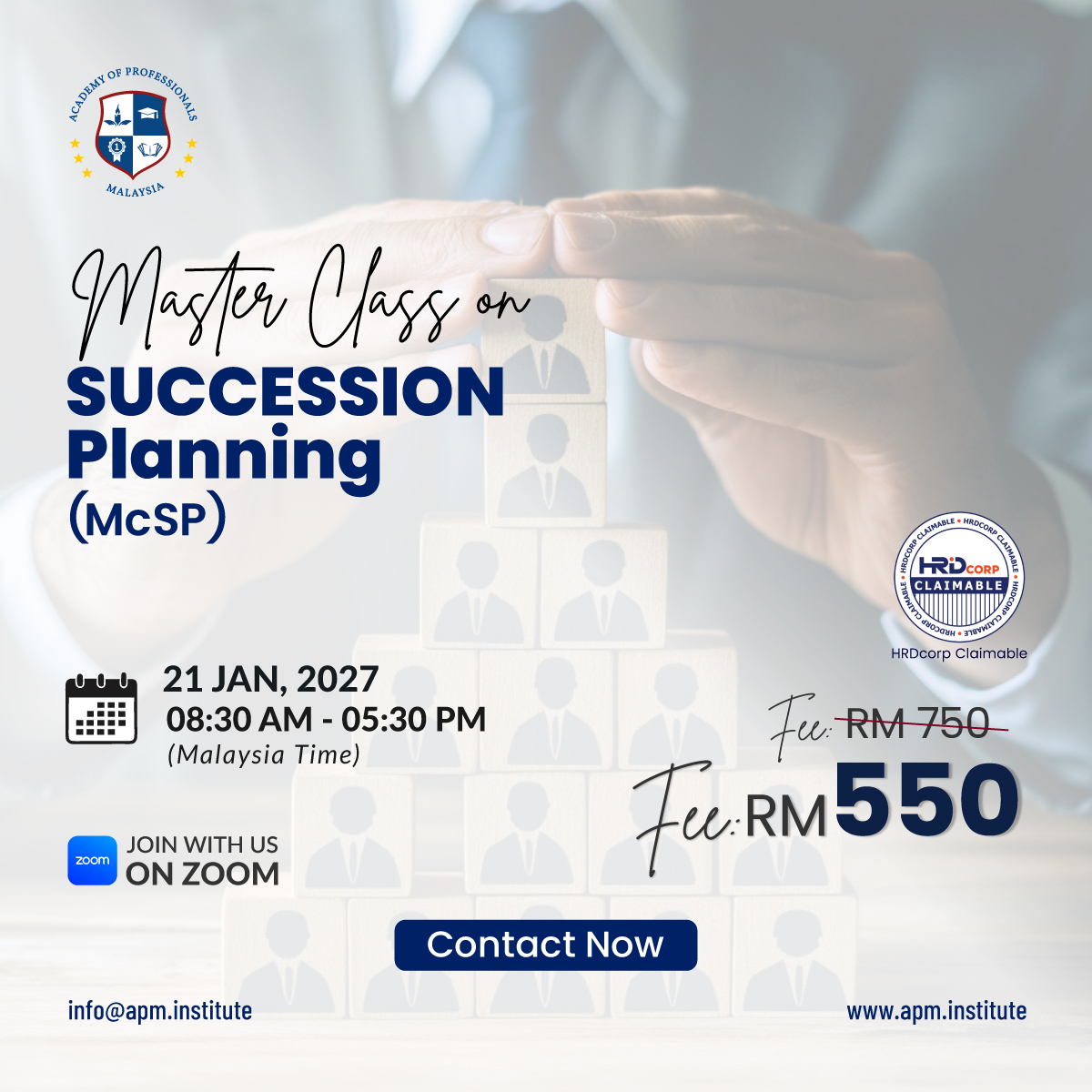
Master Class on Succession Planning the discipline of making sure the right people are ready for the roles that matter most, before those roles fall vacant. It is no longer an annual replacement chart for the top team. It is a continuous business system that protects strategy, revenue and operational stability from the loss of critical talent.
Most organisations already have a succession plan on paper. Far fewer have successors who are genuinely ready. The usual gaps are familiar: plans cover only the C-suite, "ready now" names are optimistic, the same few people appear on every slate, development is a training course rather than real experience, and nobody tracks whether the plan actually worked when a vacancy arose.
This programme moves participants from replacement planning to succession management. It treats succession as a pipeline that runs from strategy to critical roles, to assessment, to development, to decision, to transition. Each step is built and tested in the room using the CROWN Succession Model, an original five-stage framework anchored in strategy-led governance.
Examples run across sectors so participants can transfer the method to their own context: a bank branch network, a manufacturing plant, a hospital, a telecom operator, a family-owned conglomerate, a public agency, an NGO and a technology scale-up. By the end of the day, each participant leaves with a working succession plan for one real critical role and the tools to scale it.
-
The programme sets out to:
- Reposition succession management as a strategic business system that protects continuity, not an HR compliance exercise.
- Introduce the CROWN Succession Model as a single, end-to-end method participants can apply in any sector.
- Equip participants to identify critical roles using business-impact and vacancy-risk criteria, not job grade alone.
- Build capability to define future-focused success profiles that reflect where the role is heading.
- Develop fair, evidence-based judgement in separating performance, potential and readiness.
- Show how to accelerate successor readiness through stretch experiences, exposure and coaching, not training alone.
- Prepare participants to design and run talent review and calibration meetings that produce credible succession slates.
- Strengthen the handling of leadership transitions, retention risk and emergency cover.
- Establish the metrics, governance roles and review cadence that keep succession plans alive and accountable.
- Reposition succession management as a strategic business system that protects continuity, not an HR compliance exercise.
-
M-1: Strategic Foundations of Succession Management
M-2: Critical Roles and Success Profiles
M-3: Assessing Potential and Readiness
M-4: Accelerating Successor Development
M-5: Talent Reviews, Calibration and Succession Slates
M-6: Transitions, Risk, Metrics and Governance
-
Exam Method:
Number of Online Final Exams: 01
Online MCQ (Multiple Choice Question) Exam
- Number of MCQ Questions: 20
- Exam Duration: 20 Minutes
- Total Marks: 40
- Pass Mark: 70%
Assignment:
- Master Class Assignment: 01
- Total Marks: 200
- Pass Mark: 70%
-
On completing the programme, participants will be able to:
- Explain the difference between replacement planning, succession planning and succession management, and make a business case for each in their organisation.
- Apply the five CROWN stages and the governance core to diagnose the maturity of their current succession practice.
- Identify and prioritise critical roles with a weighted scoring grid covering strategic impact, scarcity, vacancy risk and time-to-fill.
- Construct a future-focused success profile with outcomes, competencies, experiences and derailers.
- Assess candidates on potential and readiness separately, using multiple evidence sources and bias checks.
- Design a 70-20-10-based acceleration plan that closes named readiness gaps within a defined timeframe.
- Facilitate a talent review and calibration discussion that results in a defensible succession slate (ready now, ready in 1–2 years, ready in 3–5 years, emergency cover).
- Plan a successor transition, including a 90-day integration plan and retention safeguards for those not selected.
- Measure succession health with bench-strength, readiness, diversity, internal-fill, and successor-success indicators.
- Produce a complete succession plan for one real critical role as the capstone deliverable.
- Explain the difference between replacement planning, succession planning and succession management, and make a business case for each in their organisation.

This program is organized by the Academy of Professionals Malaysia (APM).

This program is Validated and Quality Assured by the World Academy for Research and Development.
- Duration: 01 Days
- Time: 08:30 AM - 05:30 PM (Malaysian Time)
- Date: 21 Jan, 2027
- Mode of Learning: Virtual Class (Via Zoom)
-
- Practical Focus Modules: 06
- Post-Completion
- Electronic Certificate
-
Strategic talent alignment
- Linking succession priorities to business strategy, risk and future capability needs
Critical role analysis
- Identifying roles whose loss would materially harm the business and defining what success in them requires
Talent assessment judgement
- Distinguishing performance, potential and readiness using multiple evidence sources
Development acceleration
- Designing experience-led plans that close specific readiness gaps quickly
Calibration and decision quality
- Running talent reviews that test judgements and produce credible slates
Transition and continuity management
- Moving successors into roles safely and protecting talent and operations during change
Succession analytics and governance (cross-cutting)
- Measuring pipeline health and assigning clear decision rights and cadence
Stakeholder influence and ethical stewardship (cross-cutting)
- Gaining leadership ownership while protecting fairness, confidentiality and inclusion
- Linking succession priorities to business strategy, risk and future capability needs
HRDC Provider Approved
RM: 550.00
RM 750.00
Start Date
2027-01-21
Total Hours
08 Hours
Course Type
Virtual Training (VILT)
Mode of Learning
Online Zoom
Schedule